
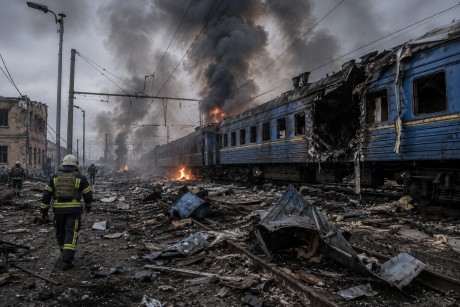
In a significant escalation of its military campaign, Russia has ramped up attacks specifically targeting Ukraine’s railway infrastructure, resulting in the deaths of six railway employees. These workers lost their lives when a ballistic missile struck a locomotive depot, illustrating Moscow’s ongoing assault on Kyiv and vital infrastructure throughout Ukraine. The recent wave of strikes has not only devastated railway facilities but also led to a broader attack on Kyiv and its surrounding regions, claiming the lives of at least 12 individuals, including children, and wounding several others.
The Ukrainian railway network, a critical component of the country’s logistical operations, has been under increasing pressure since the onset of Russia’s full-scale invasion. The network, which facilitates the movement of civilians, supplies, and military equipment, has seen a sharp rise in targeted attacks this year, with officials reporting over 1,500 incidents. This figure already surpasses the number of attacks recorded throughout the previous year. The railway authorities have reported that 58 of their employees have been killed and more than 300 injured, while hundreds of locomotives and carriages have suffered damage.
The nature of these attacks has evolved over time. Initially focusing on bridges and railway tracks, Russian forces have shifted to targeting locomotives, depots, and electrical infrastructure. This tactic, particularly damaging as Ukraine grapples with a shortage of air-defense systems, has seen increased use of drones and missiles. As a result, passenger services have also been severely disrupted, with trains that once boasted high punctuality now facing significant delays. Passengers and railway workers frequently seek shelter during air-raid alerts, causing some delays to extend for several hours.
Ukraine’s railway system, spanning approximately 24,000 kilometers, remains a vital artery for the nation’s economy and wartime logistics. Continuous Russian attacks threaten to further impair industrial activities, exports, and the crucial movement of people and goods. In response to this ongoing threat, Ukrainian officials have urged their Western allies to supply additional air-defense systems to safeguard the railway infrastructure from relentless missile and drone strikes.
The recent increase in Russian drone strikes, which includes the deployment of over 1,500 drones in recent assaults, has heightened the urgency for Ukraine to protect its railway network. Among these are newer jet-powered models, which pose a greater challenge to intercept. As the frequency of these attacks continues to rise, Ukraine grapples with the pressing need to shield its railway network, which remains a lifeline for both its civilians and military efforts.