
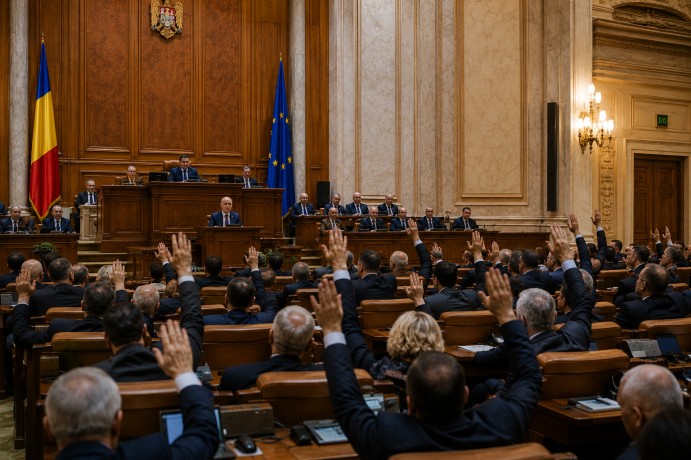
Romania remains entrenched in a political crisis, as the country’s Parliament has once again failed to approve a new government. Adrian Vestea, the candidate nominated for Prime Minister, was unable to gather the necessary support, securing only 189 votes when 233 were needed to form a government. This setback prolongs the period without a functioning administration to six weeks, leaving Romania in a state of uncertainty.
Following the unsuccessful vote, Vestea expressed his frustration, noting that he had exerted all efforts to establish a government that could bring an end to the ongoing political turmoil. The focus now shifts to President Nicușor Dan, who is tasked with nominating another candidate for the prime ministerial role. The new nominee will have a time frame of 10 days to assemble a cabinet that can gain the approval of Parliament.
Romanian law stipulates that if two successive nominees fail to achieve parliamentary endorsement within a 60-day period, Parliament may be dissolved, paving the way for early elections. This legal framework looms over the current political landscape, exacerbating the challenges faced by those attempting to broker a viable government. Analysts are increasingly suggesting that a minority government might be the most feasible option to break the deadlock.
The political impasse is occurring against a backdrop of significant economic hurdles for Romania. The country is grappling with a substantial budget deficit and the imperative to access recovery funds from the European Union. These economic pressures add urgency to the need for a stable government capable of addressing and managing these challenges effectively.
As the situation develops, Romania’s leaders are under immense pressure to find a resolution that can stabilize the political scene and address the pressing economic issues. The international community and Romanian citizens alike watch closely, anticipating the next steps that will hopefully guide the country out of this prolonged political stalemate.